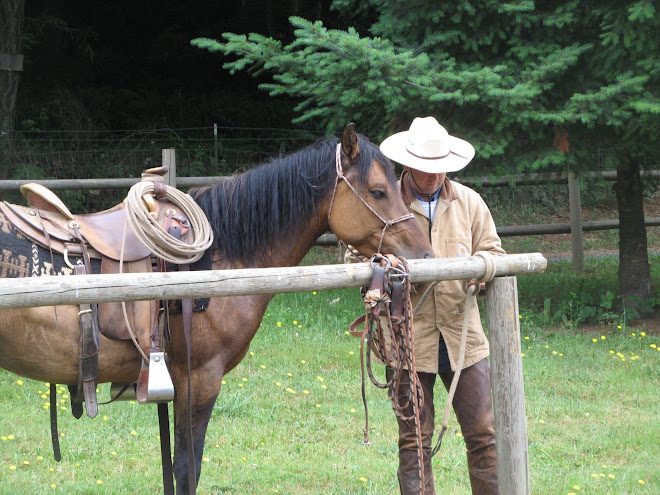
Sorry, I have been bad this month getting posts up. I will be getting post up more regularly this month. I promise.
Don't forget the Ricky clinic is coming up April 30th - May 3rd, if you haven't already, let me know if you are planning on riding, the classes are filling up. We are doing two foundation horsemanship classes.
Enjoy the Journey
Nick Donohue
Tuesday, February 24, 2009


Sunday, February 1, 2009
Do you have your horses attention?
It is important when working with your horse that you have and maintain your horses attention. You cannot expect your horse to respond when you ask them to do something if they are not focused on you with their attention. Now, at the same time, we cannot ask our horse to forsake their natural ability to be aware of their surroundings, without this horses would not have survived the years. So with that being said, it is okay if something catches the horses attention momentarily, but they must not linger, their attention must come back to you. Of course that can be easier said than done sometimes.
So how do you keep your horses attention and bring it back when they linger? First, Be particular about this, but don't be picky. Don't get to upset if they linger a little, and don't act like a controlling human, instead, if the horses attention lingers for even a second, just bring it back to you. Use your leg to draw the nose the opposite direction the horses is focused on if you can, if not, use your rein, after you leg of course. When doing this don't be upset with your horse, remember it is their nature, but at the same time correct it with no bad feelings.
Okay, now the hard part, being consistent. You cannot expect your horse to offer you their undivided attention, if you are not consistent in asking for it. You have to be aware of where your horses attention is, this can be a difficult thing for the human to get. They want to get up on the horse and operate it like a machine, turn it on and let it do the work. Unfortunately for the human, it doesn't work that way, you must be mentally engaged with the horse at all times. If your not, how do you expect your horse to be mentally engaged with you?
Lastly, keep it interesting, don't just go ride around the arena day after day doing the same ole things time after time. Mix it up, get out and ride on the trail or on some open country. Find a friend with some cattle and learn to work cows. Give your horse a job, but give him one he can enjoy, not day after day of sitting in a cubical doing the same menial tasks. Make his ride something he will find interesting and look forward to doing rather then dreading and checking out.
Enjoy the Journey
Nick
So how do you keep your horses attention and bring it back when they linger? First, Be particular about this, but don't be picky. Don't get to upset if they linger a little, and don't act like a controlling human, instead, if the horses attention lingers for even a second, just bring it back to you. Use your leg to draw the nose the opposite direction the horses is focused on if you can, if not, use your rein, after you leg of course. When doing this don't be upset with your horse, remember it is their nature, but at the same time correct it with no bad feelings.
Okay, now the hard part, being consistent. You cannot expect your horse to offer you their undivided attention, if you are not consistent in asking for it. You have to be aware of where your horses attention is, this can be a difficult thing for the human to get. They want to get up on the horse and operate it like a machine, turn it on and let it do the work. Unfortunately for the human, it doesn't work that way, you must be mentally engaged with the horse at all times. If your not, how do you expect your horse to be mentally engaged with you?
Lastly, keep it interesting, don't just go ride around the arena day after day doing the same ole things time after time. Mix it up, get out and ride on the trail or on some open country. Find a friend with some cattle and learn to work cows. Give your horse a job, but give him one he can enjoy, not day after day of sitting in a cubical doing the same menial tasks. Make his ride something he will find interesting and look forward to doing rather then dreading and checking out.
Enjoy the Journey
Nick
Tuesday, January 27, 2009
Some points on Desensitizing
In the "Natural Horsemanship" world today, you hear a lot about desensitizing horses on TV shows, clinics and demonstrations. There was a great article in the Jan/Feb issue of Eclectic Horseman, which if you don't already get it, you ought to go to www.eclectichorseman.com and subscribe, about this very subject. It got me thinking about this and I just wanted to add my thoughts about the subject.
1) Anymore horse people do everything they can to desensitize their horse, you see them introduce thing after thing, increasing the pressures until the horse learns to desensitize from these elements and essentially dull down, taking away their self preservation which has been essential in their survival. Then that same person goes and has to use excessive pressure to get the horse go operate and they wonder why their horses are not responsive and soft. Well the short answer is they took all that softness and responsiveness out when they did all the desensitization with the horse. Now I agree a certain level of desensitization is needed to be safe, you need to get a saddle on the horse, so you must desensitize them to a saddle blanket and saddle, they must be desensitized enough to touch and groom, swing a rope on, this should be enough to get the horse comfortable and confident, but much more beyond that is too much. Many times when a horse has been over desensitized and becomes dull, if and when they ever do "wake up" it usually ends up a pretty bad deal, people kid themselves into thinking a dull horse is a safe horse, when in reality, a light responsive horse, one that you can direct their feet with ease, is truly a safe horse.
2) Horses are around today because of their heightened sensitivity to their surroundings, without this, we would not have horses today. Now who are we to take it away from them, as Martin Black states in this article "Personally, I don't like to think that we should be trying to desensitize on of God's creations that He has made so sensitive. Horses are very intelligent, naturally sensitive animals, and such high sensitivity is essential to their survival. It is not "Natural" for them to operate without it." We should keep that in mind when we are working with our horses, anymore the word "Natural" is thrown around and used by anyone with a rope halter and a snaffle bit, well when you are working with your horse, really think it through, what is "Natural" for the horse.
3) Now here is another quote from the article, but I have heard this or at least something similar at a Ray Hunt clinic, and a Buck clinic. Really think about this: "People like to think they are more intelligent than the horse. If this is true, they should be able to rise to the horse's level of sensitivity and intuition instead of "desensitizing" the horse to their level." As trainers, handlers, horseman, or just horse people, if we truly want what is good for the horse, we must rise to their level.
Well, I hope this gives you something to think about and hopefully helps you improve your horsemanship. Always Remember "Enjoy the Journey"
1) Anymore horse people do everything they can to desensitize their horse, you see them introduce thing after thing, increasing the pressures until the horse learns to desensitize from these elements and essentially dull down, taking away their self preservation which has been essential in their survival. Then that same person goes and has to use excessive pressure to get the horse go operate and they wonder why their horses are not responsive and soft. Well the short answer is they took all that softness and responsiveness out when they did all the desensitization with the horse. Now I agree a certain level of desensitization is needed to be safe, you need to get a saddle on the horse, so you must desensitize them to a saddle blanket and saddle, they must be desensitized enough to touch and groom, swing a rope on, this should be enough to get the horse comfortable and confident, but much more beyond that is too much. Many times when a horse has been over desensitized and becomes dull, if and when they ever do "wake up" it usually ends up a pretty bad deal, people kid themselves into thinking a dull horse is a safe horse, when in reality, a light responsive horse, one that you can direct their feet with ease, is truly a safe horse.
2) Horses are around today because of their heightened sensitivity to their surroundings, without this, we would not have horses today. Now who are we to take it away from them, as Martin Black states in this article "Personally, I don't like to think that we should be trying to desensitize on of God's creations that He has made so sensitive. Horses are very intelligent, naturally sensitive animals, and such high sensitivity is essential to their survival. It is not "Natural" for them to operate without it." We should keep that in mind when we are working with our horses, anymore the word "Natural" is thrown around and used by anyone with a rope halter and a snaffle bit, well when you are working with your horse, really think it through, what is "Natural" for the horse.
3) Now here is another quote from the article, but I have heard this or at least something similar at a Ray Hunt clinic, and a Buck clinic. Really think about this: "People like to think they are more intelligent than the horse. If this is true, they should be able to rise to the horse's level of sensitivity and intuition instead of "desensitizing" the horse to their level." As trainers, handlers, horseman, or just horse people, if we truly want what is good for the horse, we must rise to their level.
Well, I hope this gives you something to think about and hopefully helps you improve your horsemanship. Always Remember "Enjoy the Journey"
Monday, January 26, 2009
2009 Horsemanship Clinics and events in Oregon and Washington
4/17/2009 - 4/19/2009,
Ricky Quinn Cow Working & Ranch Roping
Brush Prairie Wa,
Mary Jo Turnbull
(368) 260-8932
http://www.rickyquinnclinics.com/
4/24/2009 - 4/26/2009
Californios Ranch Roping and Stock Horse Comp.
Red Bluff California
http://www.thecalifornios.com/
4/30/2009 - 5/03/2009
Ricky Quinn Foundation Horsemanship & Colt Starting
Hillsboro, Or
Nick/Jessie Donohue
(503) 593-8775
Info@donohuehorsemanship.com
http://www.rickyquinnclinics.com/
5/07/2009 - 5/10/2009
Ricky Quinn Horsemanship 1 Ranch Roping
Ellensburg, WA
Kyler Bear
(509) 859 - 3794
http://www.rickyquinnclinics.com/
5/16/2009 - 5/17/2009
Jordan Valley Big Loop Rodeo
Jordan Valley, Or
http://www.biglooprodeo.com/
7/17/2009 - 7/20/2009
Buck Clinic Horsmanship 1 and Ranch Roping
Redmond, Or
Daphne Story
(541) 420-2677
http://www.brannaman.com/
7/31/2009- 8/3/2009
Joe Wolter Colt Starting, Horsmanship, & Cow Working
North Plains, Or
Tanya
(503) 381 - 1201
http://www.joewolter.com/
9/11/2009 - 9/14/2009
Ricky Quinn Jr Foundation Horsemanship, Horsemanship 1
Enum Claw, Wa
Liz Clark
(206) 794 - 4906
http://www.rickyquinnclinics.com/
9/18/2009 - 9/21/2009
Ricky Quinn Jr Horsemanship 1 Cow Working
Philomath, Or
Laura Lilly
(541) 953 - 4415
http://www.rickyquinnclinics.com/
10/30/2009-11/2/2009
Buck Clinic Horsemanship 1 & 2
Spanaway, Wa
Cathi Bauer
(206) 755 -5764
http://www.brannaman.com/
Ricky Quinn Cow Working & Ranch Roping
Brush Prairie Wa,
Mary Jo Turnbull
(368) 260-8932
http://www.rickyquinnclinics.com/
4/24/2009 - 4/26/2009
Californios Ranch Roping and Stock Horse Comp.
Red Bluff California
http://www.thecalifornios.com/
4/30/2009 - 5/03/2009
Ricky Quinn Foundation Horsemanship & Colt Starting
Hillsboro, Or
Nick/Jessie Donohue
(503) 593-8775
Info@donohuehorsemanship.com
http://www.rickyquinnclinics.com/
5/07/2009 - 5/10/2009
Ricky Quinn Horsemanship 1 Ranch Roping
Ellensburg, WA
Kyler Bear
(509) 859 - 3794
http://www.rickyquinnclinics.com/
5/16/2009 - 5/17/2009
Jordan Valley Big Loop Rodeo
Jordan Valley, Or
http://www.biglooprodeo.com/
7/17/2009 - 7/20/2009
Buck Clinic Horsmanship 1 and Ranch Roping
Redmond, Or
Daphne Story
(541) 420-2677
http://www.brannaman.com/
7/31/2009- 8/3/2009
Joe Wolter Colt Starting, Horsmanship, & Cow Working
North Plains, Or
Tanya
(503) 381 - 1201
http://www.joewolter.com/
9/11/2009 - 9/14/2009
Ricky Quinn Jr Foundation Horsemanship, Horsemanship 1
Enum Claw, Wa
Liz Clark
(206) 794 - 4906
http://www.rickyquinnclinics.com/
9/18/2009 - 9/21/2009
Ricky Quinn Jr Horsemanship 1 Cow Working
Philomath, Or
Laura Lilly
(541) 953 - 4415
http://www.rickyquinnclinics.com/
10/30/2009-11/2/2009
Buck Clinic Horsemanship 1 & 2
Spanaway, Wa
Cathi Bauer
(206) 755 -5764
http://www.brannaman.com/
Monday, January 19, 2009
Q/A about yeilding the front end
This is an e-mail question I received, I thought I would go ahead and post both the question and answer on the blog as it is a pretty common problem facing many people learning these groundwork techniques.
Question:
I am having the most difficult time getting Montana to yield her front end/shoulder. She keeps pushing into me, and if she does yield, she still arcs her body into me instead of flexing it away. Any advice? I don't know what else to tell you, so if you have questions, please ask and I will tell you what I can about what I am doing.
Answer:
Now when you are yielding the fronts, is this from a stand still and you are walking the fronts around the hinds away from you, or is this from the circle, with him moving around you, un-tracking the hindquarters and then stepping the fronts across. We assumed that you were talking about walking the horse around you, un-tracking the hindquarters and then stepping the fronts across away from you, so our answer only will make sense if that is what you were doing.
It sounds like you have a few things going on. First, you don't have your horses attention, if he is looking away from you and running you over, it is not paying attention to you. You also do not have the horses respect, if he respected your space, he would not be running you over. Both of these things are very important for your safety and your ability to direct your horse both from the ground and from the saddle. Keep that in mind as you work through the following things.
Anyways, first start with your circle, how is he yielding his body, is her body on the same arc as the circle, is he traveling a correct circle with his feet, his inside hind foot should line up with his outside front foot while walking the circle if he is tracking correctly. Is his head and neck arced around the circle looking the direction he is traveling or is his focus to the outside of the circle with his shoulder is coming in towards you (My guess is this is what you are having happen). First to get his head towards you and his should away, you will have to bump on the lead rope (maybe pretty hard) to bump his head towards you, this bump should be rhythmic, don't just pull on him, you can't win a pulling contest. If you can get the timing right with his inside hind, it will make it a lot easier (bumping his head towards you as the inside hind is leaving the ground). This will step the inside hind up under her belly, drifting the hindquarters to the outside of the track of the front quarters causing the horse to arc her ribs and shoulders away and around you. This might cause the shoulder to come in towards you or the horse to stop its front end, if either of these things happen, swing your rope towards the shoulder, if after one swing the horse as not responded to the swing of the rope, make contact with the horse. Be firm enough if you make contact that it means something to the horse, don't be afraid to firm up, but also only do what is necessary. Once he is traveling rounded, tracking correctly and is soft, it is time to un-track the hindquarters. Change hands on the lead rope as you step in towards the hindquarters of the horse, this should cause the horse to arc more towards you with his head and neck and his hindquarters should be moving away from you, if his shoulder or head is pushing into you, let him run into your elbow with the side of his head, make sure he runs into hard enough he moves away from you and thinks twice about stepping on you again. Now, once the horse is un-tracking its hindquarters pause your feet open up your leading hand and lead the fronts across, if the horse comes towards you, bump your leading rein and firm up on the shoulder, head, neck with the lead rope, do whatever is necessary to get that horse to yield away from you. Now you should be going the other direction, repeat the above steps and continue to work on both sides, remember, each time doesn't have to be perfect, it just has to be better than the time before, give it time and he will come around.
Here are a few links to post on my blog that should help with this, watch the videos and read the posts before you try this, they might help clear this up and get you on your way.
http://buckaroohorsemanship.blogspot.com/2008/12/circling-up-part-1-flexing-head-and.html
http://buckaroohorsemanship.blogspot.com/2008/12/cirlcing-up-part-2-getting-hindquarters.html
http://buckaroohorsemanship.blogspot.com/2008/12/ground-work-freeing-up-your-hind-and.html
http://buckaroohorsemanship.blogspot.com/2009/01/drifting-hindquarters.html
http://buckaroohorsemanship.blogspot.com/2009/01/is-your-horse-crowding-you.html
Well, I know this is a lot of information to absorb, just remember take it slow, maybe read over this stuff a time or two, then try it, come home and re-read it again. Best of luck, if you have any other questions, please let me know
Enjoy the Journey
Nick & Jessie
Question:
I am having the most difficult time getting Montana to yield her front end/shoulder. She keeps pushing into me, and if she does yield, she still arcs her body into me instead of flexing it away. Any advice? I don't know what else to tell you, so if you have questions, please ask and I will tell you what I can about what I am doing.
Answer:
Now when you are yielding the fronts, is this from a stand still and you are walking the fronts around the hinds away from you, or is this from the circle, with him moving around you, un-tracking the hindquarters and then stepping the fronts across. We assumed that you were talking about walking the horse around you, un-tracking the hindquarters and then stepping the fronts across away from you, so our answer only will make sense if that is what you were doing.
It sounds like you have a few things going on. First, you don't have your horses attention, if he is looking away from you and running you over, it is not paying attention to you. You also do not have the horses respect, if he respected your space, he would not be running you over. Both of these things are very important for your safety and your ability to direct your horse both from the ground and from the saddle. Keep that in mind as you work through the following things.
Anyways, first start with your circle, how is he yielding his body, is her body on the same arc as the circle, is he traveling a correct circle with his feet, his inside hind foot should line up with his outside front foot while walking the circle if he is tracking correctly. Is his head and neck arced around the circle looking the direction he is traveling or is his focus to the outside of the circle with his shoulder is coming in towards you (My guess is this is what you are having happen). First to get his head towards you and his should away, you will have to bump on the lead rope (maybe pretty hard) to bump his head towards you, this bump should be rhythmic, don't just pull on him, you can't win a pulling contest. If you can get the timing right with his inside hind, it will make it a lot easier (bumping his head towards you as the inside hind is leaving the ground). This will step the inside hind up under her belly, drifting the hindquarters to the outside of the track of the front quarters causing the horse to arc her ribs and shoulders away and around you. This might cause the shoulder to come in towards you or the horse to stop its front end, if either of these things happen, swing your rope towards the shoulder, if after one swing the horse as not responded to the swing of the rope, make contact with the horse. Be firm enough if you make contact that it means something to the horse, don't be afraid to firm up, but also only do what is necessary. Once he is traveling rounded, tracking correctly and is soft, it is time to un-track the hindquarters. Change hands on the lead rope as you step in towards the hindquarters of the horse, this should cause the horse to arc more towards you with his head and neck and his hindquarters should be moving away from you, if his shoulder or head is pushing into you, let him run into your elbow with the side of his head, make sure he runs into hard enough he moves away from you and thinks twice about stepping on you again. Now, once the horse is un-tracking its hindquarters pause your feet open up your leading hand and lead the fronts across, if the horse comes towards you, bump your leading rein and firm up on the shoulder, head, neck with the lead rope, do whatever is necessary to get that horse to yield away from you. Now you should be going the other direction, repeat the above steps and continue to work on both sides, remember, each time doesn't have to be perfect, it just has to be better than the time before, give it time and he will come around.
Here are a few links to post on my blog that should help with this, watch the videos and read the posts before you try this, they might help clear this up and get you on your way.
http://buckaroohorsemanship.blogspot.com/2008/12/circling-up-part-1-flexing-head-and.html
http://buckaroohorsemanship.blogspot.com/2008/12/cirlcing-up-part-2-getting-hindquarters.html
http://buckaroohorsemanship.blogspot.com/2008/12/ground-work-freeing-up-your-hind-and.html
http://buckaroohorsemanship.blogspot.com/2009/01/drifting-hindquarters.html
http://buckaroohorsemanship.blogspot.com/2009/01/is-your-horse-crowding-you.html
Well, I know this is a lot of information to absorb, just remember take it slow, maybe read over this stuff a time or two, then try it, come home and re-read it again. Best of luck, if you have any other questions, please let me know
Enjoy the Journey
Nick & Jessie
Friday, January 9, 2009
Holding yourself accountable
While you ride and work with your horse, it is important that you are mentally engaged in the riding, evaluating what is happening with your horse and how you are responding. A good way to keep yourself accountable for this is to keep a ride journal. In my journal after every ride I write down a few things about my ride: what felt really good with the horse, where we made improvement over our last ride, what didn't feel so good about the ride, how I responded to this situation and how effective it was. Did it get better, stay the same or did I make it worse? Every ride, I evaluate myself, what did I do that was an improvement from my last ride or rides, where my weaknesses were and what I should have done instead. While I am riding, I always commit 100% to what I am doing in the moment, then evaluate it when I am done. This way I give the horse 100% of me, if it was wrong, I note it and avoid doing it again, if it worked, great, I note that and keep it up.
Now it is really important to be brutally honest about your ride and yourself; this is your journal and if you truly want to grow as a person and a horseman, you first must be honest with yourself, because as we all know, "the horse doesn't lie".
Enjoy the Journey
Now it is really important to be brutally honest about your ride and yourself; this is your journal and if you truly want to grow as a person and a horseman, you first must be honest with yourself, because as we all know, "the horse doesn't lie".
Enjoy the Journey
Sunday, January 4, 2009
New Lesson Horse


Here are some pics of our new Lesson horse! We haven't named her yet, so leave a message if you have any good name ideas for her.
Subscribe to:
Posts (Atom)